What is Cobalt Plating and Why is it Important in 2026?
Cobalt plating is gaining traction in various industries. In 2026, its significance is undeniable. According to a 2022 market report, the cobalt plating market is expected to grow by 7% annually. This increase reflects the rising demand for durable protective coatings.
The aerospace and automotive sectors are primary users of cobalt plating. These industries benefit from its exceptional wear resistance. Cobalt offers superior protection against corrosion compared to other metals. However, not all processes achieve the desired results. Some manufacturers struggle with consistency in plating thickness. This inconsistency can lead to product failures and increased costs.
Cobalt plating also presents challenges in environmental regulations. As concerns about sustainability increase, companies must adapt. There is a need for methods that minimize harmful waste. Industry leaders are exploring innovative techniques to address this issue. The future of cobalt plating depends on advancements in both technology and environmental practices. Balancing performance and sustainability will be crucial for its growth.

What is Cobalt Plating?
Cobalt plating involves applying a thin layer of cobalt to a surface. This process enhances wear resistance and corrosion protection. Industries, such as aerospace and automotive, use cobalt plating for critical components and tools. The shiny finish provides an appealing look. However, producing uniform coatings can be challenging.
Quality control is essential during cobalt plating. Factors like temperature and solution concentration affect outcomes. Inconsistent results can lead to shorter product life. Regular monitoring helps to achieve desired thickness and adhesion. Moreover, the environmental impact of cobalt sourcing raises concerns. Finding sustainable sources is crucial for future practices.
In 2026, cobalt plating will likely play a pivotal role. As industries evolve, so do their requirements. Balancing performance and sustainability will be a major task. Companies must adapt to new technologies and regulations. This evolution will shape the future of cobalt plating. It's a complex journey, needing constant reflection and adjustment.
What is Cobalt Plating and Why is it Important in 2026?
| Aspect |
Details |
| Definition |
Cobalt plating is an electroplating process that deposits a layer of cobalt onto a surface to improve its properties. |
| Applications |
Used in aerospace, automotive, and electronics for corrosion resistance, wear resistance, and improved electrical conductivity. |
| Benefits |
Enhanced durability, increased lifespan of components, reduced friction, and improved performance under harsh conditions. |
| Regulatory Trends |
Stricter regulations on toxic materials have made cobalt plating safer and more environmentally friendly. |
| Market Demand |
Growing demand in the renewable energy sector and high-performance industries is expected to drive cobalt plating use in 2026 and beyond. |
| Future Outlook |
Innovations in plating technology and materials research are anticipated to enhance the efficiency and applicability of cobalt plating. |
The Process of Cobalt Plating Explained
Cobalt plating is a critical process in modern manufacturing. This technique involves applying a layer of cobalt to various substrates. The primary goal is to improve the surface properties of the materials. Cobalt plating enhances hardness, corrosion resistance, and wear resistance. These features are vital for components in demanding environments, such as aerospace and automotive.
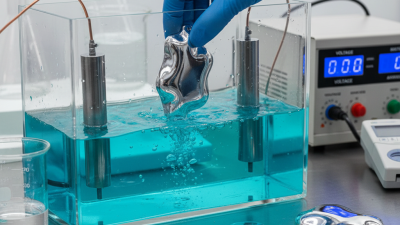
The process begins with cleaning the substrate. This step is crucial for achieving proper adhesion. Next, the substrate is immersed in a cobalt-rich solution. An electric current is then applied, allowing cobalt ions to deposit evenly. While this method is effective, it can sometimes result in uneven coatings. Even minor imperfections may lead to performance inconsistencies. Operators must monitor the process closely to avoid these issues.
After the plating process is complete, the surface should be polished. This step can reveal hidden flaws that need addressing. Although cobalt plating can offer significant benefits, it is not without challenges. Companies must invest time in refining their techniques. Continuous learning is essential to achieve the desired quality standards. This refining process can be long, but it is necessary for excellent results in the end.
Applications of Cobalt Plating in Various Industries
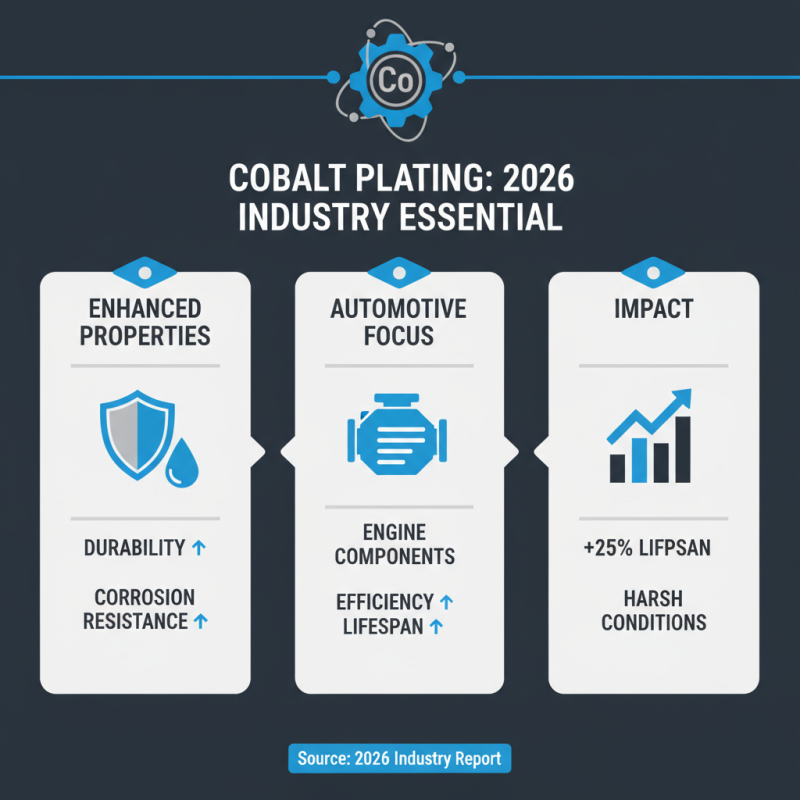
Cobalt plating is increasingly vital across various industries in 2026. It offers unique properties that enhance durability and corrosion resistance. The automotive sector utilizes cobalt plating for engine components. This application improves engine efficiency and extends lifespan. According to a recent industry report, cobalt-plated components can last 25% longer under harsh conditions compared to untreated parts.
In electronics, cobalt plating provides excellent thermal conductivity. It is used in connectors and circuit boards. A study showed that cobalt-coated connectors had a 40% lower failure rate than non-plated options. This improvement is crucial in high-performance electronic devices where reliability is essential. However, sourcing high-quality cobalt remains a challenge. Environmental concerns and mining regulations complicate production processes.
Aerospace is another field benefiting from cobalt plating. Parts exposed to extreme conditions require extra protection. Cobalt coatings can withstand high temperatures and mitigate wear. Yet, the costs associated with cobalt plating are significant. Companies must weigh the benefits against financial constraints. The balance is difficult, especially for smaller manufacturers seeking to compete.
Advantages of Cobalt Plating Over Other Coatings
Cobalt plating has gained popularity in recent years. It offers distinct advantages over traditional coatings. This process enhances wear resistance and improves the lifespan of coated products. Cobalt creates a tough layer that protects against corrosion. This is crucial in demanding environments where materials face constant stress.
One notable benefit of cobalt plating is enhanced adhesion. Unlike some coatings, cobalt bonds tightly to surfaces. This reduces the risk of peeling or chipping. The smooth finish of cobalt plating also improves the overall aesthetic appeal of items. Many industries, such as aerospace and automotive, have reported better performance from cobalt-plated components.
However, there are challenges. Cobalt plating can be more complex to apply than other methods. The need for precise conditions during the plating process requires skilled technicians. Improvements in methods are still necessary to enhance efficiency. Balancing quality and cost is also a frequent concern for manufacturers. Despite these challenges, the benefits often outweigh the drawbacks.
Advantages of Cobalt Plating Over Other Coatings in 2026
Future Trends and Developments in Cobalt Plating by 2026
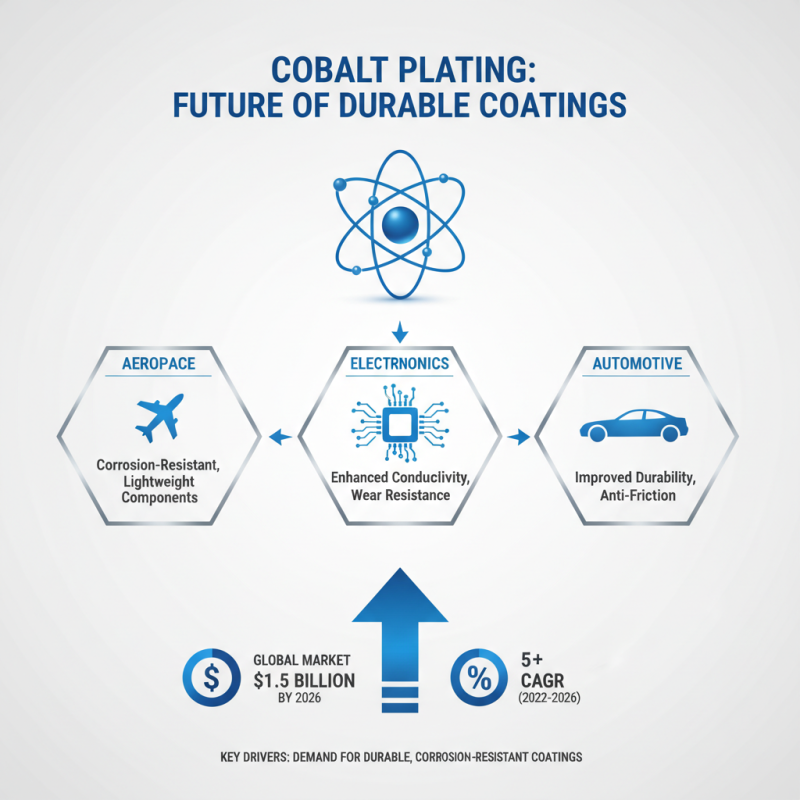
Cobalt plating is gaining traction in multiple industries due to its unique properties. By 2026, advancements in cobalt plating technologies are expected to reshape applications in aerospace, electronics, and automotive sectors. A recent market report suggests that the global cobalt plating market could reach $1.5 billion by 2026, reflecting a compound annual growth rate (CAGR) of over 5%. This growth indicates a rising demand for durable, corrosion-resistant coatings.
Innovations in cobalt plating are crucial. Novel techniques, such as pulse plating, enhance uniformity and adhesion. These methods can lead to improved performance in extreme conditions. However, the industry must acknowledge potential environmental and health concerns related to cobalt extraction. Cobalt production can have significant ecological impacts, with some regions facing pollution issues. Therefore, sustainable practices are essential for future growth.
Additionally, as industries prioritize high-performance materials, cobalt alloys will play a vital role. The integration of cobalt in multi-layer coatings could enhance wear resistance and longevity. Despite these advances, there are challenges. The price volatility of cobalt can hinder steady supply chains. Manufacturers must navigate these complexities to fully harness cobalt’s potential by 2026.